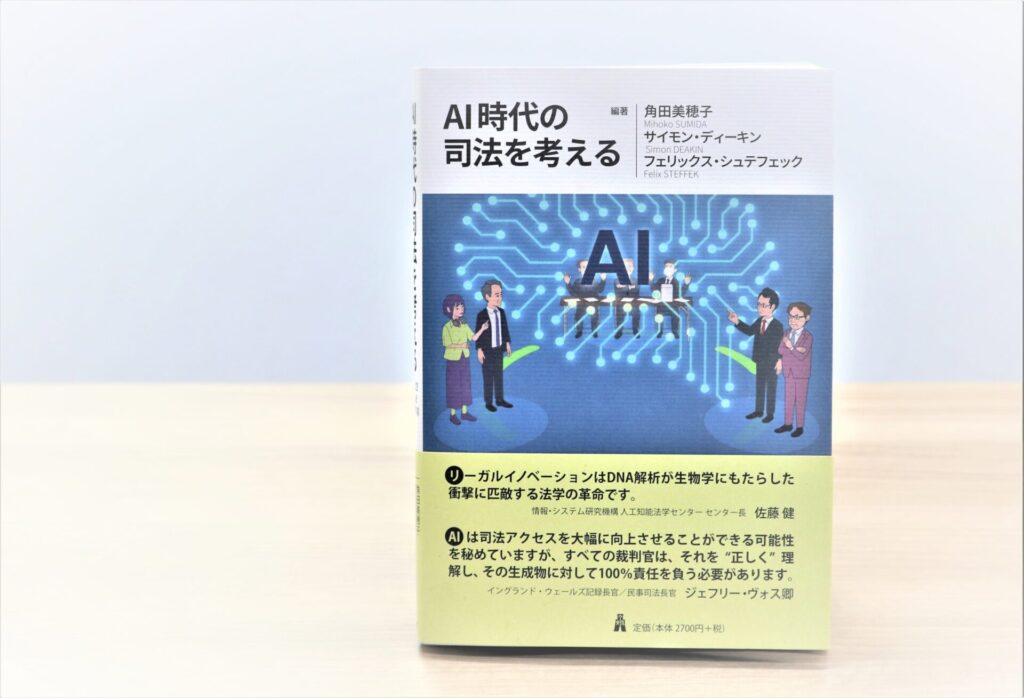
『AI時代の司法を考える(Justice in the Age of AI)』 co-edited by Mihoko Sumida (Professor, HIAS), Simon Deakin (HIAS Visiting Researcher, Professor, University of Cambridge), Felix Steffek (Professor, University of Cambridge), has been published.
2026/01/28
This Book is the published record of the finale event for the “Legal Systems and Artificial Intelligence” project (https://legalinnovation.hias.hit-u.ac.jp/en/). This event can be described as historic, marking the first presentation of the outcomes of legal innovation research conducted jointly by Hitotsubashi University and the University of Cambridge.
The book is structured in three parts, examining how innovation in AI technology can intersect with the “Justice”, and what future may emerge from such an intersection.
Part One considers “Society and Law Transformed by Technology”. It is now widely recognised that technology profoundly alters economic activity and social life. Yet how does this relate to “Law” and “Justice”? Surprisingly, this relationship has scarcely been explored in depth until now. This section aims to establish why reflecting on “Law” and “Justice” is crucial today, inviting readers to share this concern.
Part 3, “The Future of Dispute Resolution: Possibilities and Challenges brought by Technology”, examines the “Justice” in the Age of AI in concrete terms. It also contemplates what future might emerge where innovations in AI technology intersect with the “Justice”. This section is likely to be where the content most directly addresses the interests of many readers.
Particularly noteworthy is the future vision articulated in his own words by Sir Geoffrey Vos, the Master of the Rolls and Chief Justice of the Civil Division, who is spearheading the digital transformation of Justice in England and Wales (Part 3, Chapter 3).
Preceding this in Part 2, the results of AI experiments are presented, questioning how far current cutting-edge AI technology can provide socially beneficial perspectives in relation to the intricate linguistic game that is “justice”. These were all epoch-making developments within the world of judicial AI research.
The contents of this book do not cover all the necessary and sufficient themes for contemplating “Justice in the Age of AI”, as stated in its title. Furthermore, however high a reliability score technologies being introduced into the judiciary may achieve within the AI research community, this merely provides one element for the broader societal debate on “How should Justice in the age of AI be?”. It is precisely this complexity that constitutes the question we have sought to address.
It would be a source of immense satisfaction if this book, by sharing cutting-edge judicial AI research with Japanese society as it prepares for the full implementation of IT in civil court proceedings (May 2026), contributes to deepening the debate about “Justice in the age of AI”.
In Chapter 4 of Part 1, we introduced a new social science called foresight to discuss the “Law” and “Justice” in the Future. This is a methodology known as Horizon Scanning, which involves gathering as much information as possible about elements that are inherently difficult to predict in the future, structuring and understanding that information, thereby creating a “preparation” and an “attitude” towards future change. The Japanese and UK teams produced animations by weaving stories based on future scenarios generated using this methodology. These animations are now made available here.
Click here for details
https://www.koubundou.co.jp/